


Heart rate training zones can help you understand how hard your body is working during exercise. Whether you enjoy walking, jogging, cycling, swimming, or strength training, learning about these zones can make your workouts easier to plan and understand.
Heart Rate Training Zones Explained: A Beginner’s Guide You may have seen fitness watches display different heart rate zones during exercise. But what do they actually mean? And how can beginners use them without making workouts unnecessarily complicated?
In this guide, you’ll learn what heart rate training zones are, how they work, how to estimate your maximum heart rate, and how to use the information to support a balanced fitness routine.

What Are Heart Rate Training Zones?
Heart rate training zones are ranges that describe how hard your cardiovascular system is working during physical activity.
They are usually calculated using your maximum heart rate, which is the highest number of beats per minute your heart can reach during intense exercise.
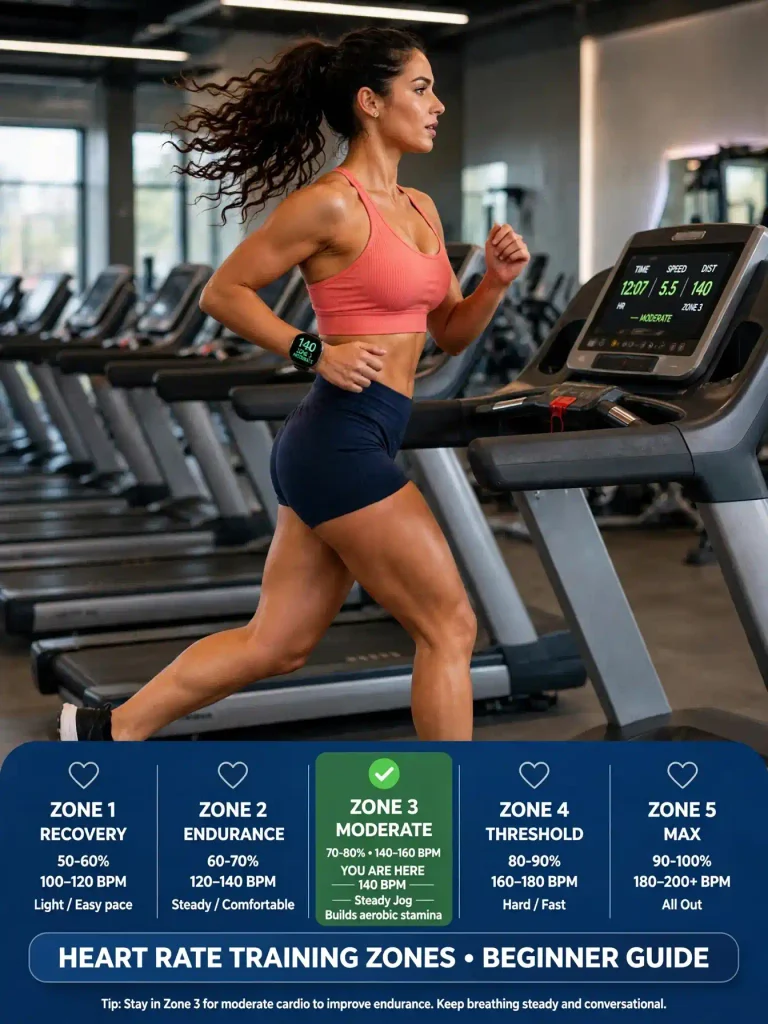
Most traditional training systems divide heart rate into five zones:
- Zone 1: Very light activity
- Zone 2: Light to moderate activity
- Zone 3: Moderate to moderately hard activity
- Zone 4: Hard activity
- Zone 5: Very hard activity
Each zone represents a different level of exercise intensity. Lower zones are generally easier to maintain for longer periods, while higher zones involve more effort and are usually sustained for shorter periods.
Remember that these ranges are estimates, not strict rules. Your fitness level, age, health, medication, stress, sleep, and environmental conditions can all influence your heart rate.
The Five Heart Rate Training Zones Explained
The traditional five-zone model uses percentages of estimated maximum heart rate. Here is a simple overview.
Zone 1: Very Light Activity (50–60%)
Zone 1 represents gentle movement that requires very little effort.
Examples include:
- Slow walking
- Gentle cycling
- Easy warm-ups
- Light movement between exercise sessions
You should be able to speak comfortably without becoming out of breath.
This zone is useful for warming up, cooling down, and adding gentle movement to your day.
Zone 2: Light to Moderate Activity (60–70%)
Zone 2 is a comfortable exercise intensity that many beginners can maintain for longer periods.
Examples include:
- Brisk walking
- Comfortable cycling
- Easy jogging, if suitable for your fitness level
- Steady swimming
At this intensity, breathing becomes slightly faster, but you should still be able to speak in complete sentences.
Zone 2 training is often discussed in connection with aerobic endurance. It can help build a foundation for activities that require sustained effort.
For beginners, comfortable walking can be a simple way to explore this intensity without needing complicated equipment.
Zone 3: Moderate to Hard Activity (70–80%)
Zone 3 involves a noticeable increase in effort.
Examples may include:
- Faster cycling
- Steady running
- Uphill walking
- More demanding aerobic workouts
Your breathing becomes heavier, and speaking in complete sentences may become more difficult.
This zone can help develop cardiovascular fitness, but beginners do not need to spend every workout exercising at this intensity.
A balanced routine can include comfortable activity alongside occasional periods of more challenging movement.
Zone 4: Hard Activity (80–90%)
Zone 4 represents high-intensity exercise.
Examples include:
- Faster running
- Challenging cycling intervals
- Uphill efforts
- Short periods of demanding cardio
Breathing becomes much heavier, and conversation is usually limited to a few words.
This level of effort can be demanding, so it is not necessary for every workout. Beginners should build a comfortable fitness foundation before considering more intense training.
Zone 5: Very Hard Activity (90–100%)
Zone 5 represents very high-intensity effort.
It may occur during short, demanding intervals or athletic performance activities.
At this intensity, speaking is difficult and the effort cannot usually be maintained for long.
This zone is not a requirement for general fitness. Beginners can make progress through comfortable, consistent activity without trying to reach their maximum heart rate.
Heart Rate Training Zones Chart
The following chart shows the traditional five-zone model.
| Training zone | Percentage of maximum heart rate | General intensity |
|---|---|---|
| Zone 1 | 50–60% | Very light |
| Zone 2 | 60–70% | Light to moderate |
| Zone 3 | 70–80% | Moderate to hard |
| Zone 4 | 80–90% | Hard |
| Zone 5 | 90–100% | Very hard |
These percentages are general estimates. Different fitness watches, coaches, and training methods may use slightly different zone boundaries.
How to Calculate Your Maximum Heart Rate
One commonly used estimate for maximum heart rate is:
Maximum heart rate = 220 − your age
For example, a person who is 30 years old would get an estimated maximum heart rate of 190 beats per minute.
However, this formula is only a rough estimate. It does not accurately predict the maximum heart rate of every individual.
Maximum heart rate can vary considerably between people of the same age. For that reason, it is better to treat calculated zones as general guidance rather than exact targets.
If you have a medical condition, take medication that affects heart rate, or have concerns about exercising, ask a qualified healthcare professional for advice before using heart-rate targets.
How to Use Heart Rate Zones as a Beginner
You do not need to spend your first workout checking your watch every few seconds. Start by understanding how different exercise intensities feel.
Here are some simple ways to use heart rate information.
1. Start With Comfortable Exercise
Walking, easy cycling, and gentle swimming are practical starting points.
Choose an activity that allows you to breathe comfortably and maintain a conversation.
2. Pay Attention to the Talk Test
The talk test is a simple way to estimate exercise intensity without relying entirely on a heart rate monitor.
- Easy intensity: You can talk comfortably.
- Moderate intensity: You can talk, but your breathing is faster.
- Vigorous intensity: You can only say a few words before taking a breath.
This approach is especially useful when a fitness watch gives confusing or inconsistent readings.
3. Include a Warm-Up and Cool-Down
Begin with a few minutes of gentle movement before increasing your pace.
At the end of your session, gradually slow down rather than stopping suddenly after demanding exercise.
4. Build Consistency Before Intensity
Beginners do not need to chase higher heart rate zones to improve their fitness.
Focus on choosing enjoyable activities, moving regularly, and allowing enough time for recovery.
5. Use Your Fitness Watch as a Guide
A smartwatch or heart rate monitor can provide useful information about your activity.
However, wrist-based sensors may sometimes produce inaccurate readings, especially during movement.
Use the numbers alongside how you feel rather than treating every reading as an exact measurement.
What Is the Difference Between Zone 2 and Zone 3 Training?
Zone 2 and Zone 3 are often compared because they represent different levels of aerobic exercise intensity.
Zone 2 is generally comfortable and sustainable. You can usually speak in complete sentences while exercising.
Zone 3 feels more demanding. Your breathing is noticeably faster, and maintaining a conversation becomes harder.
Both can be part of a balanced fitness routine. The most appropriate intensity depends on your experience, goals, recovery, and overall health.
For beginners, there is no need to force yourself into a particular zone. Comfortable movement is a good place to start.
Common Mistakes When Using Heart Rate Zones
Heart rate training can be helpful, but it is easy to misunderstand the numbers.
Watch out for these common mistakes:
Treating Estimated Zones as Exact Numbers
Heart rate formulas are not perfect. Two people of the same age may have different heart rate responses to the same activity.
Trying to Reach Zone 4 or Zone 5 Every Workout
Higher intensity does not automatically mean a better workout. Comfortable activity has an important place in a balanced routine.
Ignoring How You Feel
Your heart rate can be affected by heat, hydration, stress, sleep, illness, and other factors.
If you feel dizzy, unusually breathless, faint, or experience chest discomfort, stop exercising and seek appropriate medical advice.
Comparing Your Heart Rate With Other People
Heart rate responses vary between individuals. Comparing your readings with someone else’s does not provide a reliable measure of fitness.
Forgetting About Recovery
Rest and recovery are important parts of a fitness routine. Give yourself time to recover between demanding activities.
Do You Need a Heart Rate Monitor?
No. A heart rate monitor is optional.
You can exercise effectively without a smartwatch or chest strap. The talk test, perceived effort, and your ability to maintain a comfortable pace can provide useful information.
If you already own a fitness tracker, it can help you notice general patterns in your activity over time.
A chest strap may provide more consistent readings during some activities, while wrist-based devices are convenient for everyday use.
The best option is the one that helps you understand your activity without making exercise feel unnecessarily complicated.
Frequently Asked Questions About Heart Rate Training Zones
What is the best heart rate zone for beginners?
There is no single best zone for everyone. Beginners can start with comfortable, light-to-moderate activity and gradually explore different intensities as their fitness and confidence develop.
Is Zone 2 training good for beginners?
Zone 2 can be a comfortable way to build aerobic endurance. Brisk walking, easy cycling, and similar activities may fit this intensity, depending on the individual.
Can I exercise without knowing my heart rate zones?
Absolutely. You can use the talk test and how hard an activity feels to guide your workouts. Heart rate zones are an optional tool, not a requirement.
Are heart rate zones the same for everyone?
No. They depend on individual factors, and estimated maximum heart rate formulas cannot predict everyone’s response accurately.
Why does my heart rate increase during an easy workout?
Heart rate can change because of temperature, hydration, stress, sleep, caffeine, illness, and other factors. An increase does not automatically mean something is wrong.
Should I train in Zone 5 to improve fitness?
No. Zone 5 is not necessary for general fitness or for beginners. A balanced routine can support cardiovascular health without frequent maximum-effort exercise.

Final Thoughts
Understanding heart rate training zones can make exercise easier to plan and help you learn how different levels of effort feel.
The five-zone model offers a useful starting point, from gentle movement in Zone 1 to very intense activity in Zone 5. However, the numbers should always be treated as estimates rather than strict targets.
If you are new to exercise, begin with comfortable activities such as walking or easy cycling. Pay attention to your breathing, build consistency gradually, and give your body enough time to recover.
The goal is not to spend every workout in a particular heart rate zone. It is to develop a balanced approach to movement that you can enjoy and maintain.



Comments are closed.
[…] Slowly lower the kettlebell back to the floor. […]