
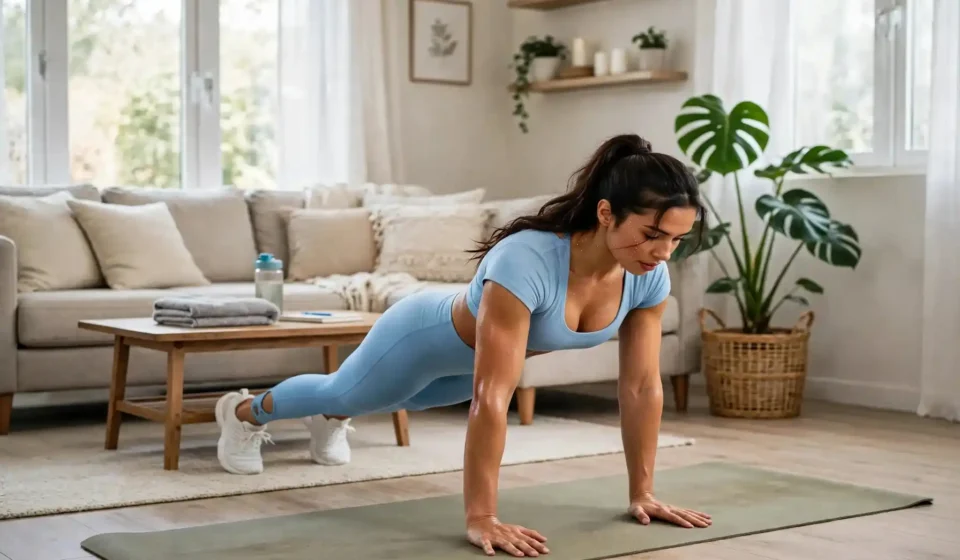

30-Minute Full-Body Workout for Beginners Getting started with exercise doesn’t have to mean spending hours at the gym or following a complicated workout plan. With just 30 minutes, you can complete a simple full-body workout that helps you build strength, improve endurance, and develop a consistent fitness routine.
If you’re new to exercise, the best approach is to start with manageable movements and gradually increase the challenge as your fitness improves. You don’t need expensive equipment or advanced training experience to get moving. Many effective exercises can be performed at home using only your body weight.
This 30-minute full-body workout for beginners combines simple strength exercises with short periods of rest to help you train your major muscle groups in one session. Whether you’re working out at home or looking for an easy routine to add to your fitness schedule, this guide will help you get started.
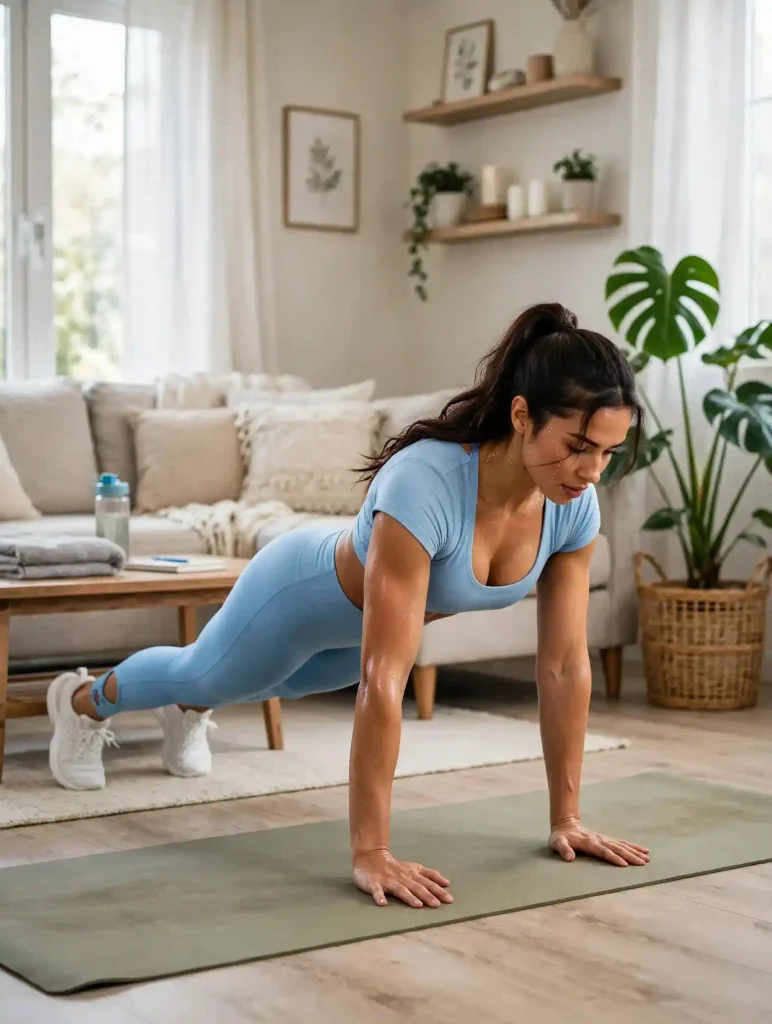
What Is a Full-Body Workout?
A full-body workout is a training session that targets several major muscle groups rather than focusing on just one area.
A balanced routine may include exercises for your legs, glutes, chest, back, shoulders, arms, and core. Training these muscle groups together can be a convenient option for beginners who want a straightforward workout schedule.
Full-body workouts can also help you learn basic movement patterns, including squatting, pushing, hinging at the hips, and stabilizing your body.
Benefits of a 30-Minute Full-Body Workout
You don’t need a long workout to build a useful exercise habit. A well-planned 30-minute session can fit into a busy schedule and provide a practical starting point.
1. Saves Time
A 30-minute routine is easier to fit around work, school, family responsibilities, and other daily activities.
2. Trains Multiple Muscle Groups
Instead of training only your upper or lower body, you can include movements that work different areas during the same session.
3. Builds Strength Gradually
Bodyweight exercises allow beginners to learn proper movement patterns before progressing to more challenging variations or adding resistance.
4. Supports Cardiovascular Fitness
When exercises are performed in a steady circuit with appropriate rest periods, your heart rate may increase. The level of cardiovascular challenge depends on the exercises, pace, and your current fitness.
5. Helps Build Consistency
A simple routine with clear instructions can make it easier to exercise regularly without feeling overwhelmed.
The Best 30-Minute Full-Body Workout for Beginners
This routine is designed for beginners and can be performed at home without special equipment. You’ll need a little space, comfortable clothing, and a stable chair or wall for support if needed.
The workout includes a warm-up, a main exercise circuit, and a cool-down.
Part 1: Warm-Up — 5 Minutes
Start with five minutes of gentle movement to prepare for your workout.
Try the following:
- March in place: 1 minute
- Arm circles: 30 seconds
- Step-touch side to side: 1 minute
- Gentle bodyweight squats: 1 minute
- Easy alternating knee lifts: 1 minute and 30 seconds
Keep the movements comfortable and controlled. If an exercise causes pain or feels unsuitable, replace it with a gentler movement.
Part 2: Full-Body Workout — 20 Minutes
Complete the following eight exercises in order. Start with one or two rounds, depending on your fitness level, and rest as needed.
For a beginner-friendly session, aim for approximately 30–40 seconds of movement per exercise, followed by 20–30 seconds of rest. Take additional recovery time between rounds if necessary.
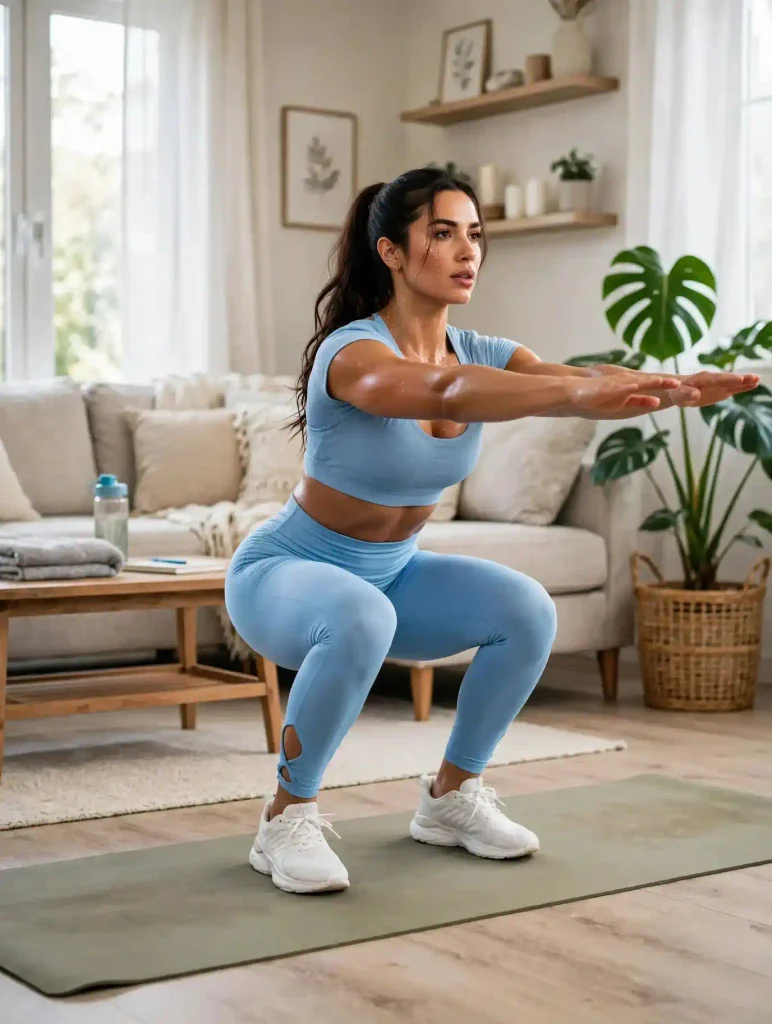
1. Bodyweight Squats
Targets: Thighs, glutes, and core
Squats are a useful foundational exercise that helps you practice sitting down and standing up with control.
How to do it:
- Stand with your feet approximately shoulder-width apart.
- Keep your chest comfortable and your feet flat on the floor.
- Push your hips backward and bend your knees.
- Lower yourself only as far as feels comfortable.
- Press through your feet to return to standing.
Beginner tip: Use a sturdy chair behind you as a target if you need help controlling the movement.
2. Wall Push-Ups
Targets: Chest, shoulders, and triceps
Wall push-ups offer an accessible way to practice an upper-body pushing movement without lowering your entire body to the floor.
How to do it:
- Stand facing a wall.
- Place your palms against the wall around chest height.
- Step backward a comfortable distance.
- Bend your elbows and bring your chest toward the wall.
- Push through your hands to return to the starting position.
Beginner tip: Stand closer to the wall to make the movement easier.
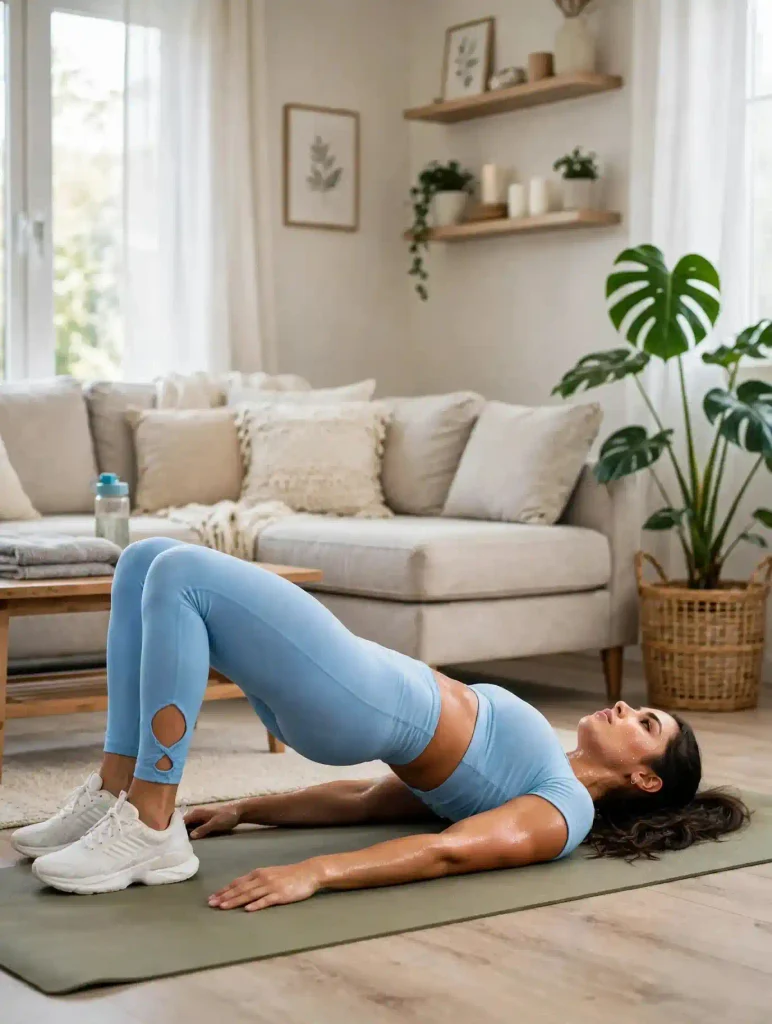
3. Glute Bridges
Targets: Glutes and the muscles around your hips
Glute bridges help you practice hip extension while lying on your back.
How to do it:
- Lie on your back with your knees bent.
- Keep your feet flat on the floor.
- Rest your arms beside your body.
- Gently tighten your glutes and lift your hips.
- Pause briefly at the top.
- Lower your hips slowly.
Beginner tip: Lift only as high as you can while keeping the movement comfortable and controlled.
4. Reverse Lunges
Targets: Legs and glutes
Reverse lunges help develop lower-body strength, balance, and coordination.
How to do it:
- Stand tall with your feet about hip-width apart.
- Step one foot backward.
- Bend both knees as far as comfortable.
- Push through your front foot to return to standing.
- Repeat on the other side.
Beginner tip: Hold a stable support if you need help with balance. You can also practice stepping backward without lowering deeply.
5. Bird Dogs
Targets: Core, back, and balance
Bird dogs encourage controlled movement while you stabilize your torso.
How to do it:
- Begin on your hands and knees.
- Keep your back in a comfortable neutral position.
- Extend one arm forward while extending the opposite leg backward.
- Pause briefly without twisting your body.
- Return to the starting position.
- Alternate sides.
Beginner tip: Start by moving only one arm or one leg at a time if coordinating both feels difficult.
6. Standing Calf Raises
Targets: Calf muscles
Calf raises are simple to perform at home and can be adapted to different fitness levels.
How to do it:
- Stand with your feet about hip-width apart.
- Hold a stable support if needed.
- Slowly lift your heels off the floor.
- Pause briefly at the top.
- Lower your heels with control.
Beginner tip: Avoid bouncing. Focus on a smooth, controlled movement.
7. Standing Hip Hinge
Targets: Glutes, hamstrings, and back muscles
The hip hinge teaches an important movement pattern used in many strength exercises.
How to do it:
- Stand with your feet about hip-width apart.
- Keep your knees slightly bent.
- Push your hips backward as your torso leans forward.
- Keep your back in a comfortable neutral position.
- Return to standing by bringing your hips forward.
Beginner tip: Practice without weights until the movement feels natural.
8. Forearm Plank
Targets: Core and shoulder stabilizing muscles
The plank is an isometric exercise, meaning you hold a position rather than repeatedly moving through a range of motion.
How to do it:
- Place your forearms on the floor.
- Extend your legs behind you.
- Keep your body aligned from your head toward your heels.
- Gently engage your core.
- Hold the position while breathing normally.
Beginner tip: Start with your knees on the floor or hold the position for 10–20 seconds. Stop when you can no longer maintain good form.
Part 3: Cool-Down — 5 Minutes
Finish your workout with five minutes of easy movement and gentle stretching.
You can include:
- Slow walking around the room
- Gentle calf stretches
- Comfortable chest stretches
- Gentle thigh stretches
- Relaxed breathing
Avoid forcing stretches or bouncing. The aim is to finish the session at a comfortable pace.
How to Fit the Workout Into 30 Minutes
Here’s a simple breakdown of the session:
| Workout section | Time |
|---|---|
| Warm-up | 5 minutes |
| Main workout circuit | 20 minutes |
| Cool-down | 5 minutes |
| Total | 30 minutes |
Your actual timing may vary depending on how many rounds you complete and how much rest you need. If you’re just starting out, it’s better to use additional rest or complete fewer rounds than rush through the exercises with poor technique.
How Many Days a Week Should Beginners Work Out?
If you’re new to strength training, two or three full-body sessions per week can be a practical starting point, with recovery time between demanding sessions.
Here’s an example schedule:
- Monday: 30-minute full-body workout
- Tuesday: Easy walk or light activity
- Wednesday: Rest or gentle mobility
- Thursday: 30-minute full-body workout
- Friday: Comfortable walk
- Saturday: Optional light activity or recreational exercise
- Sunday: Rest
Adjust the schedule to your needs and current fitness level. You don’t need to exercise intensely every day to establish a healthy routine.
How to Make the Workout More Challenging
As the exercises become easier, you can gradually increase the difficulty.
Consider these options:
- Add a few repetitions while maintaining good form.
- Increase the length of each exercise interval slightly.
- Complete another round when you’re ready.
- Try a more challenging exercise variation.
- Add light dumbbells to suitable movements.
Change one thing at a time rather than making every part of the workout harder at once.
Common Beginner Workout Mistakes
Skipping the Warm-Up
Starting immediately with challenging exercises may feel uncomfortable. Use a few minutes of gentle movement to prepare.
Moving Too Quickly
Rushing through repetitions can make it harder to control your technique. Choose a pace that allows you to move smoothly.
Doing Too Much Too Soon
Your first workout doesn’t need to leave you exhausted. Start with a manageable number of rounds and build gradually.
Ignoring Rest Days
Recovery helps you maintain a consistent routine. Allow your body time to recover between demanding strength sessions.
Comparing Your Progress With Others
People begin exercise with different levels of experience and ability. Focus on your own consistency, technique, and gradual progress.
Final Thoughts
A 30-minute full-body workout for beginners is a practical way to start building an exercise habit at home. With simple movements such as squats, wall push-ups, glute bridges, reverse lunges, and planks, you can work several major muscle groups without needing a gym membership.
Start at a comfortable level, take breaks whenever necessary, and focus on learning each exercise correctly. As your fitness improves, gradually increase the challenge rather than trying to do everything at once.
Remember that consistency matters more than perfection. A manageable workout you can repeat regularly is a strong foundation for long-term fitness.
If you have an existing injury, a health condition that affects exercise, or concerns about starting a new routine, seek advice from a qualified healthcare professional before beginning.


Comments are closed.
[…] Weight training is a form of resistance exercise that uses dumbbells, barbells, resistance machines, resistance bands, or body weight to challenge the muscles. […]