
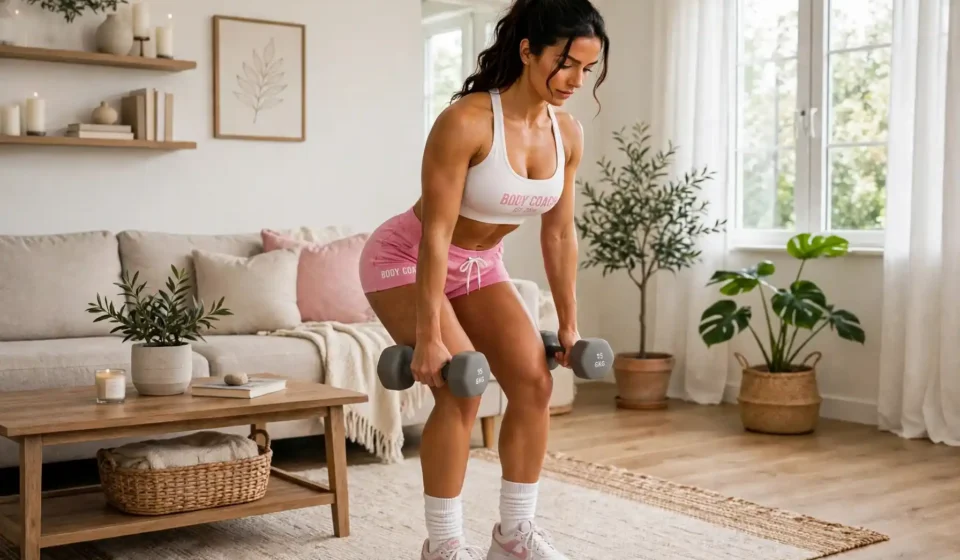

You don’t need a full gym setup to start getting stronger. A pair of dumbbells and a little space at home can be enough to create an effective beginner dumbbell workout that trains your entire body.
The Best Dumbbell Workout for Beginners at Home Dumbbells are especially useful for beginners because they allow you to perform a wide range of exercises while gradually increasing resistance as you become stronger. You can use them to train your legs, glutes, back, chest, shoulders, arms, and core without needing complicated machines.
If you’re new to strength training, the most important thing isn’t lifting the heaviest weight possible. It’s learning good technique, choosing a manageable weight, and building a routine you can stick with.
This guide walks you through a simple full-body dumbbell workout for beginners at home, including eight exercises, how to perform them, and how to structure your weekly routine.
Why Use Dumbbells at Home?
Dumbbells are one of the most convenient pieces of strength-training equipment for a home workout.
They take up very little space and can be used for both upper- and lower-body exercises. You can also adjust the difficulty simply by changing the weight or modifying an exercise.
A beginner dumbbell routine can help you:
- Build muscular strength
- Improve coordination and balance
- Strengthen your major muscle groups
- Make everyday movements easier
- Develop a consistent exercise habit
- Progress without needing a large collection of equipment
You don’t need several pairs of heavy weights to begin. Start with a resistance that allows you to perform the exercises with control.
8 Dumbbell Exercises for Beginners at Home
The following exercises create a balanced full-body workout. Perform them with light or moderate dumbbells and focus on smooth, controlled movements.
1. Dumbbell Goblet Squat
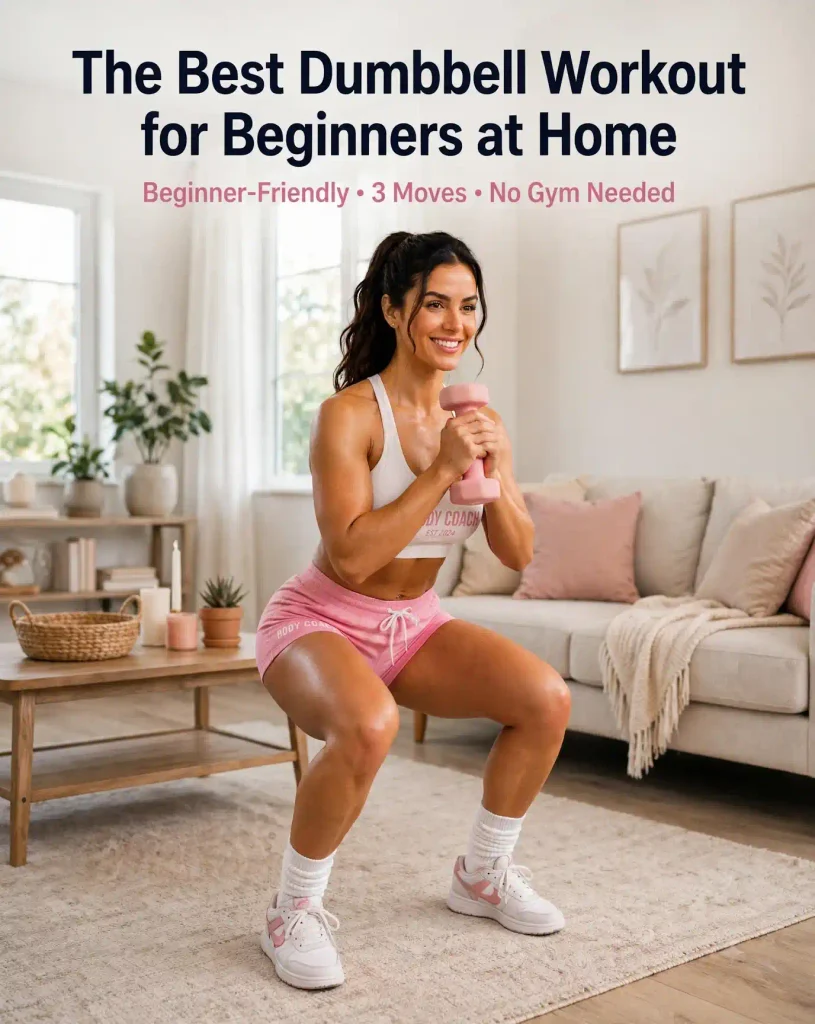
The goblet squat is a beginner-friendly way to introduce resistance to a basic squat. It primarily works your legs and glutes while also requiring your core to stabilize your body.
How to do it
- Stand with your feet roughly shoulder-width apart.
- Hold one dumbbell vertically with both hands in front of your chest.
- Keep your chest lifted and your back in a comfortable neutral position.
- Bend your knees and push your hips backward.
- Lower yourself as far as feels comfortable.
- Push through your feet to return to standing.
Beginner target: 2–3 sets of 8–12 repetitions.
Keep the dumbbell close to your chest throughout the movement.
2. Dumbbell Romanian Deadlift
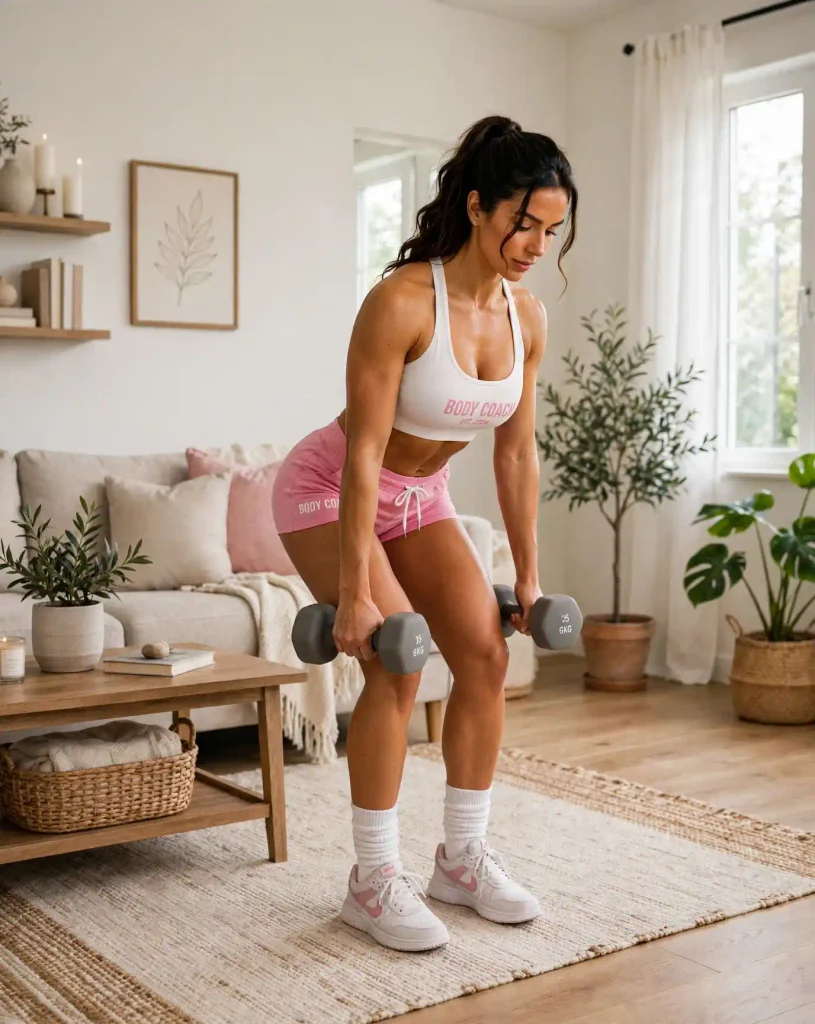
The Romanian deadlift is a useful exercise for strengthening the back of your legs and glutes while teaching you how to hinge at your hips.
How to do it
- Stand with your feet about hip-width apart.
- Hold a dumbbell in each hand in front of your thighs.
- Keep your knees slightly bent.
- Push your hips backward while lowering the dumbbells along the front of your legs.
- Keep your back in a comfortable neutral position.
- Lower the weights only as far as you can while maintaining good control.
- Drive your hips forward to return to standing.
Beginner target: 2–3 sets of 8–12 repetitions.
Think about moving from your hips rather than simply bending forward at your waist.
3. Dumbbell Floor Press
Don’t have a bench at home? No problem. A dumbbell floor press gives you a simple way to train your chest, shoulders, and triceps.
How to do it
- Lie on your back with your knees bent and feet flat on the floor.
- Hold a dumbbell in each hand.
- Position your elbows comfortably on the floor.
- Press the dumbbells upward until your arms are extended.
- Slowly lower the weights until your upper arms gently touch the floor.
- Press them back up.
Beginner target: 2–3 sets of 8–12 repetitions.
Use a weight you can control throughout the entire movement.
4. One-Arm Dumbbell Row
Rows are an important addition to a balanced home workout because they train your upper back and arms.
How to do it
- Place one hand on a sturdy chair or another stable surface.
- Step one foot slightly behind you.
- Hold a dumbbell in your opposite hand.
- Keep your back in a comfortable neutral position.
- Pull the dumbbell toward your hip.
- Pause briefly at the top.
- Slowly lower the weight.
Beginner target: 2–3 sets of 8–12 repetitions per side.
Try not to twist your torso as you pull the dumbbell.
5. Dumbbell Shoulder Press
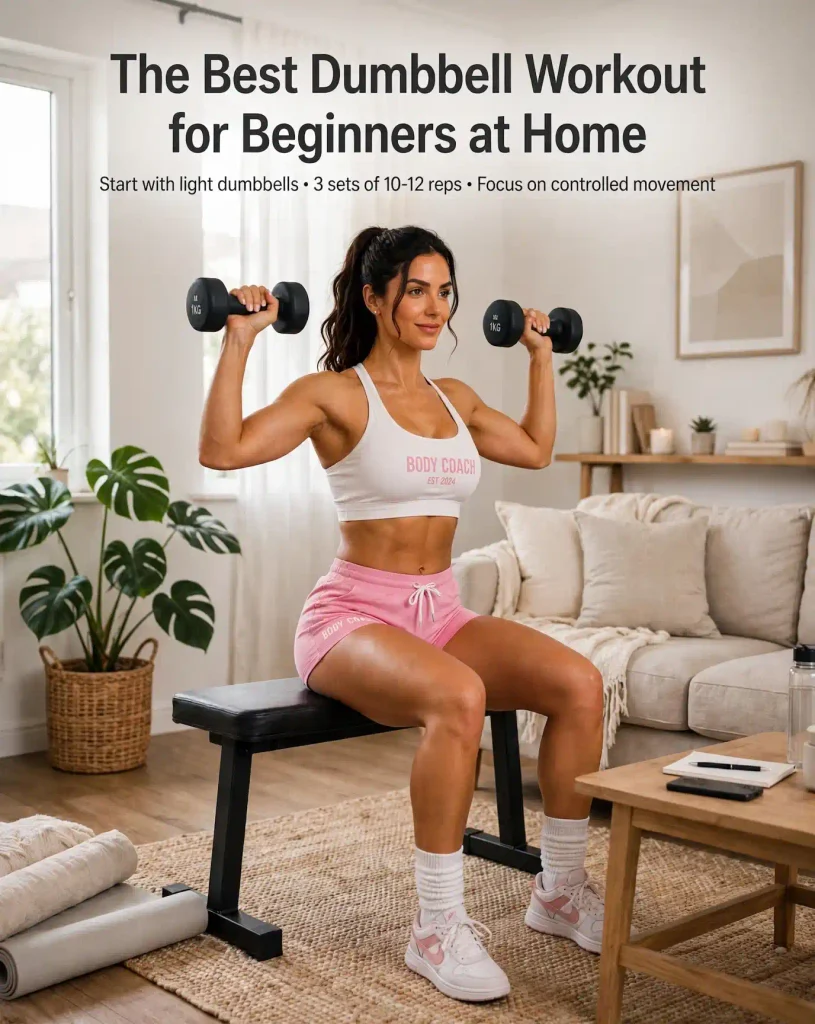
The shoulder press targets the shoulders and also involves the triceps.
How to do it
- Stand or sit with your back in a comfortable position.
- Hold a dumbbell in each hand at about shoulder height.
- Keep your wrists steady.
- Press the dumbbells upward.
- Stop before forcing your elbows into an uncomfortable position.
- Slowly lower the weights back to shoulder height.
Beginner target: 2 sets of 8–12 repetitions.
If standing makes it difficult to control your body, try the exercise while seated on a stable chair.
6. Dumbbell Reverse Lunge
Reverse lunges work your legs and glutes while also challenging balance and coordination.
How to do it
- Stand tall while holding a dumbbell in each hand.
- Take one foot backward.
- Bend both knees and lower your body under control.
- Keep most of your weight supported through the front foot.
- Push through the front foot to return to standing.
- Alternate sides.
Beginner target: 2 sets of 6–10 repetitions per leg.
If balance is difficult, practice the movement without dumbbells first or use a stable support.
7. Dumbbell Biceps Curl
Biceps curls are simple and effective for beginners who want to include direct arm training in their workout.
How to do it
- Stand with a dumbbell in each hand.
- Keep your arms beside your body.
- Keep your elbows close to your sides.
- Bend your elbows and curl the weights toward your shoulders.
- Pause briefly.
- Slowly lower the dumbbells.
Beginner target: 2 sets of 10–15 repetitions.
Avoid swinging your body to move the weights. If you need to swing, the dumbbells are probably too heavy.
8. Dumbbell Farmer Carry
The farmer carry is a simple full-body exercise that challenges your grip, shoulders, core, and legs.
How to do it
- Hold a dumbbell in each hand.
- Stand tall with your shoulders relaxed.
- Keep your core gently engaged.
- Walk slowly and maintain good posture.
- Continue for a comfortable distance or amount of time.
- Put the weights down carefully.
Beginner target: 2–3 rounds of 20–40 seconds.
Keep your steps controlled and avoid leaning from side to side.
A Simple Full-Body Dumbbell Workout
You don’t need to perform every exercise separately on different days. Beginners can combine the movements into one simple full-body session.
Beginner Workout
1. Goblet squat: 8–12 reps
2. Romanian deadlift: 8–12 reps
3. Floor press: 8–12 reps
4. One-arm row: 8–12 reps per side
5. Shoulder press: 8–12 reps
6. Reverse lunge: 6–10 reps per leg
7. Biceps curl: 10–15 reps
8. Farmer carry: 20–40 seconds
Start with 2 sets of each exercise. Rest as needed between sets, especially when you’re learning the movements.
As you become more comfortable, you can gradually increase the challenge.
How Heavy Should Dumbbells Be for Beginners?
There isn’t one perfect dumbbell weight for everyone.
The right weight should allow you to perform the exercise with good control while still making the final few repetitions feel challenging.
If your technique breaks down, your range of motion becomes inconsistent, or you need to swing the weight to complete the movement, choose a lighter dumbbell.
It’s better to start lighter and learn the movement than to choose a weight that’s too heavy.
How Often Should Beginners Do Dumbbell Workouts?
For most beginners, two or three full-body strength workouts per week can provide a practical starting point.
For example:
Monday: Full-body dumbbell workout
Tuesday: Walking or light activity
Wednesday: Rest
Thursday: Full-body dumbbell workout
Friday: Light cardio or mobility
Saturday: Optional workout or recreational activity
Sunday: Rest
You can adjust this schedule based on your experience, availability, and recovery.
How to Progress Your Dumbbell Workout
Your body will gradually adapt as you repeat the same exercises. When a workout starts feeling noticeably easier, you can make small adjustments.
Try one change at a time:
- Add a few repetitions
- Add another set
- Increase the dumbbell weight slightly
- Use a more challenging variation
- Improve your movement control
- Increase your walking or carrying time
You don’t need to make every workout harder. Progress happens over time, and recovery is an important part of the process.
Common Beginner Mistakes
Choosing weights that are too heavy
More weight doesn’t automatically mean a better workout. Choose a resistance that allows you to maintain good technique.
Moving too quickly
Slow, controlled repetitions can help you learn the movement and stay aware of your form.
Skipping warm-ups
Spend a few minutes doing light movement before your workout. This can help you prepare mentally and physically for the session.
Training the same muscles every day
Your muscles need time to recover after strength training. Give yourself rest between demanding full-body sessions.
Comparing your progress with someone else
Everyone starts from a different fitness level. Focus on improving your own strength, technique, and consistency.
How to Make Your Home Workout More Effective
You don’t need complicated training techniques to get more from your dumbbell workouts.
Focus on the basics:
Use good technique. Learn each exercise before increasing the weight.
Stay consistent. A simple routine you follow regularly is more useful than an elaborate program you rarely complete.
Track your workouts. Write down your weights, repetitions, and sets so you can see your progress.
Give yourself time. Strength and fitness improve gradually.
Listen to your body. Normal muscular effort is different from sharp or unusual pain. Stop an exercise if something feels wrong.
Final Thoughts
A pair of dumbbells can give beginners everything they need for a simple and effective home strength workout. With exercises such as goblet squats, Romanian deadlifts, rows, floor presses, lunges, and carries, you can train many of the major muscle groups without needing a gym full of equipment.
Start with manageable weights, learn the movements, and gradually increase the challenge as you become stronger.
The goal isn’t to have the hardest workout possible. The goal is to build a strength-training routine that you can perform consistently and enjoy over time.
If you’re completely new to exercise, have an injury, or have a health condition that could affect your workouts, consider speaking with a qualified healthcare professional before starting a new exercise program.


Comments are closed.
[…] In this guide, you’ll learn what Japanese Walking is, how it works, its potential benefits, how to do it correctly, and how beginners can build it into a weekly routine. […]